 866-222-3025

What Are the Best Veterinary Ultrasound Machines? Complete Buyer’s Guide 2026

Veterinary ultrasound machines are essential diagnostic tools that help veterinarians diagnose diseases in both large and small animals without radiation exposure. The best veterinary ultrasound machines for 2026 include the GE Logiq e Vet Bovine Equine (best for large farm animals, $14,500-$21,750), the Hitachi Arietta 50 VET (best cart-style system for practices), and the Hitachi Prologue VET (best portable option for vet practices). At Strata Imaging, we help veterinary practices choose the right ultrasound equipment based on their specific needs, whether for small animal clinics, equine practices, or large farm animal care.
| Ultrasound Machine: | GE Logiq e Vet Bovine Equine | Hitachi Arietta 50 VET | Hitachi Prologue VET |
| Ranking | Best Portable Veterinary Ultrasound Machine for Large Farm Animals | Best Cart-Style Ultrasound Machine for Veterinary Practices | Best Portable Veterinary Ultrasound Machine for Vet Practices |
| Price Range | $14,500-$21,750 | ||
| 3D/4D Imaging | No, 2D only | No, 2D only | No, 2D only |
| Display Size | 15” | 21.5” LCD | 11.6” LCD |
| Image Quality | 1024×768 resolution | HD- 1280×1024 resolution | 1920×1080 |
| Controls | Trackball, knobs, and buttons | Knobs, buttons, trackball, and touchscreen panel | Touchpanel |
| Battery Life | 2 hours | No battery | 1.5 hours |
| Workflow Features: | Simultaneous split-screen scanning, SmartScan, ComfortScan, anatomy-specific image settings, customer settings | Fully customizable controls, user-friendly touchscreen, dynamic slow-motion display, simplified control layout, auto optimizer | Anatomy specific resets, intuitive touch control, eFlow, easy transport, Adaptive tissue filter |
| Vet Features: | Equine sports medicine features. Reproductive scanning for bovine, equine, and swine. CW Doppler for cardiac vet scans, deep probe penetration | Quick vascular and cardiac scans, eFlow, Silky Image Processing, Trapezoidal Imaging | eFlow, Silky Image Processing, Trapezoidal Imaging, Dual CF, Adaptive tissue filter |
| What sets it apart: | Great balance of features and affordability. Large farm animal scanning capabilities | Exceptional system performance, image quality, and full vet feature set | Rapid boot time, intuitive operation, ScanSync, compound imaging |
What Features Should You Look for in a Veterinary Ultrasound Machine?
Veterinary ultrasound machines provide noninvasive, radiation-free diagnostic imaging with quick results. These specialized machines come with veterinary-specific presets that optimize settings for animal anatomy, making them more efficient than adapting human ultrasound equipment.
Why Veterinary-Specific Ultrasound Machines Matter
Veterinary ultrasound machines work similarly to human ultrasounds but include software presets specifically designed for animal anatomy. For example, imaging a dog’s heart requires different contrast, frequency, focus, and depth settings than imaging a human heart. Choosing a machine with optimal presets for your practice type, whether small animal, equine, or large animal, helps you capture more accurate images while saving valuable exam time.
Common Diagnostic Uses for Veterinary Ultrasounds
Veterinarians commonly use ultrasound machines to diagnose conditions and guide procedures, including:
- Detecting bladder stones and urinary tract issues
- Diagnosing heart problems and cardiac abnormalities
- Guiding biopsies and tissue sampling procedures
- Obtaining urine samples directly from the bladder (cystocentesis)
- Reproductive scanning and pregnancy monitoring
- Evaluating abdominal organs and soft tissue structures
Understanding Ultrasound Frequency and Penetration
Ultrasound frequency directly affects image quality and penetration depth. Higher-frequency sound waves (10-16 MHz) provide better resolution for organs directly beneath the skin, making them ideal for small animal scanning. Lower-frequency ultrasounds (1-2 MHz) offer deeper penetration, which is essential for imaging large animals like horses, cattle, and zoo animals.
What Imaging Options Are Available?
Veterinary ultrasound machines offer various imaging capabilities:
- 2D Black and White Imaging: Standard for most diagnostic applications, providing clear cross-sectional views
- 3D Imaging: Uses sound waves from multiple directions to create three-dimensional images for better spatial understanding
- 4D Imaging: Provides live video imaging, showing movement in real-time
- Color Doppler: Highlights blood flow direction and velocity using color coding
- Power Doppler: Detects small movements in blood vessels and tissues
The best veterinary ultrasound machines feature plug-and-play capabilities, requiring minimal adjustments during exams for streamlined workflow.
What Is the Best Portable Veterinary Ultrasound Machine for Practices?
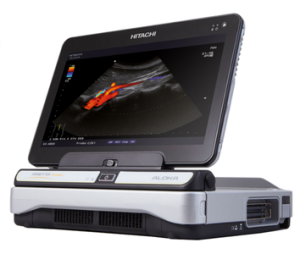
The Hitachi Prologue VET is the best portable veterinary ultrasound machine for veterinary practices. This compact system combines intuitive touchscreen controls with advanced imaging technology, making it ideal for both in-clinic use and mobile veterinary services.
Key Features of the Hitachi Prologue VET
The Hitachi Prologue VET offers veterinary-specific features designed for efficient workflow:
- 11.6-inch LCD monitor with 1920×1080 high-definition resolution
- 1.5 hours of battery life for mobile veterinary work
- Rapid boot time to minimize wait time between patients
- Anatomy-specific settings for quick optimization across different species
- ScanSync system that uses transducer movements to freeze, unfreeze, and store images
- Touchscreen with virtual keyboard for easy control and data entry
- Compatible with or without a standard ultrasound cart for flexibility
Advanced Imaging Technology
The Hitachi Prologue VET includes several advanced imaging technologies:
- Adaptive Tissue Filter: Uses computer enhancement to make tissue type differences easier to detect
- Silky Image Processing (SIP): Reduces speckles and sharpens image edges for clearer definition
- Trapezoidal Imaging: Provides a larger field of view than the transducer width
- Compound Imaging Software: Combines images from slightly different angles for improved visualization
- eFlow High-Definition Blood Flow Imaging: Displays fine blood vessels that conventional methods struggle to show
- Dual CF: Displays color Doppler and black-and-white B-mode images simultaneously
- Needle Visualization: Enhanced imaging for guided procedures
The customizable menu and intuitive interface make the Hitachi Prologue VET particularly user-friendly for veterinary technicians and veterinarians alike.
What Is the Best Portable Veterinary Ultrasound Machine for Large Farm and Zoo Animals?
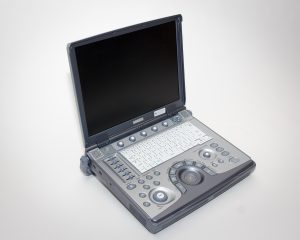
The GE Logiq e Vet Bovine Equine is the best portable veterinary ultrasound machine for large farm animals, offering an excellent balance between advanced features and affordability. Priced between $14,500 and $21,750, this laptop-sized system is specifically designed for equine, bovine, and other large animal scanning.
Why the GE Logiq e Vet Excels for Large Animals
This ultrasound machine is purpose-built for large animal veterinary work. With the appropriate probes, the GE Logiq e Vet can scan as deep as 30 centimeters, allowing veterinarians to visualize organs and limbs in horses, cattle, and other large animals. Its compact, laptop-sized design makes it easy to transport to farms, ranches, and zoos for on-site diagnostics.
Key Features of the GE Logiq e Vet Bovine Equine
The GE Logiq e Vet Bovine Equine includes:
- 15-inch monitor for clear viewing in various lighting conditions
- 1024×768 resolution for detailed imaging
- 2-hour battery life for extended field work
- Solid-state hard drive for reliable data storage
- USB ports for easy data transfer and connectivity
- Trackball and convenient knobs and buttons for precise control
Specialized Large Animal Features
The system includes features specifically valuable for large animal veterinary work:
- Equine sports medicine features for performance horse evaluation
- Reproductive scanning capabilities for bovine, equine, and swine breeding programs
- CW Doppler for cardiac veterinary scans
- Deep probe penetration up to 30 cm for large animal anatomy
- CrossXBeam compound imaging that combines images from different angles for clearer pictures
- Power Doppler Imaging (PDI) to detect small movements in blood vessels and tissues
- Pulse Wave Doppler (PWD) for monitoring blood flow rates
- Color Flow Doppler to highlight blood flow direction during cardiac scans
What Is the Best Cart-Style Veterinary Ultrasound Machine?
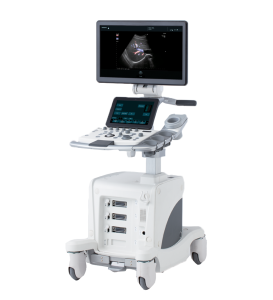
The Hitachi Arietta 50 VET is the best cart-style veterinary ultrasound machine, offering exceptional system performance, image quality, and a comprehensive veterinary feature set. This premium system is ideal for established veterinary practices that prioritize image quality and advanced diagnostic capabilities.
Control and Interface Features
The Hitachi Arietta 50 VET provides multiple control options for user preference:
You can control the system using the trackball, touchscreen, knobs, and buttons. The controls are fully customizable, and a simplified layout makes them especially user-friendly for both experienced veterinarians and newer staff members.
Display and Image Quality
The system features:
- 21.5-inch LCD monitor for excellent visibility
- 1024×768 resolution for clear, detailed images
- Automatic image optimization that adjusts settings in real-time
- Silky Image Processing for reduced speckle and enhanced edge definition
- Trapezoidal imaging for expanded field of view
Specialized Veterinary Capabilities
The Hitachi Arietta 50 VET excels in specific veterinary applications:
- Quick vascular and cardiac scans with optimized presets
- Dynamic Slow-Motion Display (DSD) that shows real-time and slow-motion images side-by-side for examining fast-moving structures like heart valves
- eFlow high-definition blood flow imaging for detailed vascular assessment
- Simplified control layout that reduces learning curve for staff
This cart-based system is designed for in-clinic use where portability is less critical than image quality and advanced features.
How Do You Choose the Right Veterinary Ultrasound Machine for Your Practice?
Choosing the right veterinary ultrasound machine depends on your practice type, patient population, and specific diagnostic needs. Consider these key factors when evaluating ultrasound equipment:
Practice Type and Patient Population
- Small Animal Practices: Look for machines with higher-frequency transducers (10-16 MHz) for better resolution of small organs. Portable or compact systems work well for exam room flexibility.
- Equine Practices: Choose portable systems with deep penetration capabilities and equine-specific presets. Battery life is crucial for barn calls and field work.
- Large Animal/Farm Practices: Select rugged, portable systems with deep scanning capabilities (up to 30 cm), long battery life, and weather-resistant designs for outdoor use.
- Mixed Animal Practices: Consider versatile systems with multiple transducer options and comprehensive preset libraries covering various species.
Portability Requirements
- Mobile Veterinary Services: Prioritize lightweight, battery-powered systems with durable construction and quick boot times.
- In-Clinic Use: Cart-based systems offer larger displays, more features, and don’t require battery considerations.
- Hybrid Approach: Some portable systems like the Hitachi Prologue VET work with or without carts, offering flexibility.
Budget Considerations
Veterinary ultrasound machines range from approximately $14,500 for quality portable systems to significantly more for premium cart-based units. Consider:
- New vs. refurbished equipment: Refurbished machines from reputable dealers like Strata Imaging offer significant savings with warranty protection
- Essential features vs. advanced capabilities: Determine which features you’ll use regularly versus occasionally
- Long-term value: Higher initial investment may provide better image quality and durability over time
Get Expert Help Choosing Your Veterinary Ultrasound Machine
With the right veterinary ultrasound equipment, you can enhance diagnostic capabilities, improve patient care, and increase practice efficiency for both small and large animals. Whether you need a portable system for farm calls, a high-performance cart-based machine for your clinic, or a versatile option that works in multiple settings, Strata Imaging can help you find the perfect solution.
Our team specializes in helping veterinary practices select ultrasound machines that match their specific needs, patient population, and budget. We offer both new and refurbished veterinary ultrasound equipment with warranty protection and ongoing support.
Contact for Price Quote
Frequently Asked Questions
Q: What is the average cost of a veterinary ultrasound machine?
A: Veterinary ultrasound machines typically range from $14,500 to over $50,000 depending on features, portability, and image quality. The GE Logiq e Vet Bovine Equine, for example, costs between $14,500 and $21,750. Refurbished machines offer significant savings while maintaining diagnostic quality.
Q: What is the difference between portable and cart-based veterinary ultrasound machines?
A: Portable veterinary ultrasound machines are lightweight, battery-powered, and designed for mobile use or space-limited clinics. Cart-based systems typically offer larger displays, more advanced features, and don’t require battery charging but are designed for stationary in-clinic use. Some systems like the Hitachi Prologue VET offer flexibility to work both ways.
Q: How deep can veterinary ultrasound machines scan?
A: Scanning depth depends on transducer frequency and machine capabilities. High-frequency transducers (10-16 MHz) scan 2-6 cm deep, ideal for small animals. Low-frequency transducers (1-2 MHz) can scan up to 30 cm deep, necessary for large animals like horses and cattle. The GE Logiq e Vet Bovine Equine can scan as deep as 30 centimeters with appropriate probes.
Q: What is the difference between 2D, 3D, and 4D ultrasound imaging?
A: 2D ultrasound provides flat, cross-sectional images and is the standard for most veterinary diagnostics. 3D ultrasound uses sound waves from multiple directions to create three-dimensional images for better spatial understanding. 4D ultrasound provides live video imaging, showing movement in real-time. Most veterinary applications use 2D imaging effectively.
Q: How long do veterinary ultrasound machines last?
A: With proper maintenance, veterinary ultrasound machines typically last 7-10 years or longer. Regular servicing, proper transducer care, and software updates extend equipment lifespan. Refurbished machines from reputable dealers can provide many additional years of reliable service.
If you are in need of an affordable option and are looking to save 30-60% over new OEM prices then allow our knowledgeable customer service and expert team to assist you in developing a solution that fits your requirements.
We offer solutions with a 100% satisfaction guarantee, ensuring you receive the best value for your investment.

FDA Certified Products

Factory OEM Specifications

100% Guarantee
Our clients
Trust Others From Around The World
Served over 4,000 Ultrasound and C-Arm Clients since 2004



